

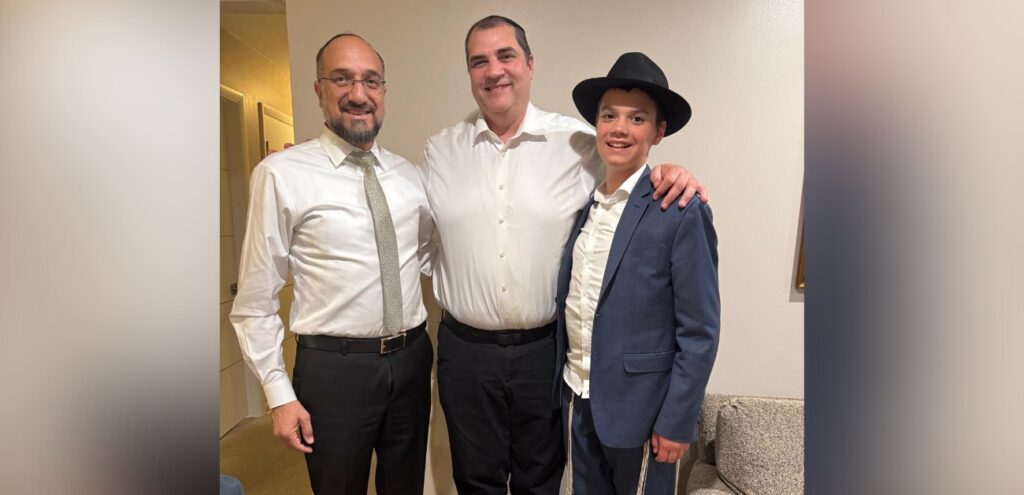
When local Orthodox Rabbi Wes Kalmar told visiting Israelis about his synagogue’s budding relationship with a secular community in Israel, they didn’t believe he was serious.
“They are from communities where it’s not religious, and they couldn’t imagine having anything religious going on there (at a secular Israeli community),” said Kalmar, of the Orthodox Anshe Sfard Kehillat Torah in Glendale.
But Kalmar and his community have only found connection since he and Rabbi Rashi Tvito, the rabbi of Kfar HaOranim, a secular Israeli community of about 550 families outside of Modi’in, Israel, were connected. The rabbis, paired through an exchange program led by the Rabbinical Council of America, which represents Orthodox rabbis, and an Israeli organization called the Barkai Center for Practical Rabbinics and Community Development, are learning from each other, with plans to connect their two communities. “He’s really great. I love him a lot,” Kalmar said of Rabbi Tvito.
Tvito is an Orthodox rabbi in a secular community, Kfar HaOranim. The residents of Kfar HaOranim asked Tvito to come to the community to be their rabbi, which Kalmar said is not typical for communities like Kfar HaOranim. “A lot of these places would never think of having a rabbi. It would be like an anathema.”
The two rabbis were paired by Rabbi David Fine, dean and founder of Barkai and former rabbi of Lake Park Synagogue in Milwaukee, which he served from 1998-2003 at the start of his rabbinical career. Fine, who has since moved to Israel, started Barkai with fellow Israeli Rabbi Shlomo Sobol to train Israeli rabbis in communal and pastoral skills.
“In the Israeli world, the shul is not really a center of community like it is in America,” Fine said. “Barkai’s goal is to create a community in Israel. We train Israeli rabbis in practical rabbinics and leadership, community leadership, entrepreneurship and all kinds of pastoral needs.”
“One of the ways that we decided to educate our rabbis is to expose them to what’s going on in America. We feel that there’s a lot that the American rabbinate and Jewish community can teach our rabbis,” Fine said, “and then we realized American rabbis really wanted to understand more of what was going on in Israel, so we started this rabbinic exchange program.”
Barkai and the Rabbinical Council of America partnered to create the program, which currently has six pairs of American and Israeli rabbis. Kalmar said he joined for the opportunity for his community to connect with one in Israel.
Kalmar and Tvito connected in May 2024. Fine, familiar with the Milwaukee Jewish community, saw similarities between Milwaukee and Kfar HaOranim, which he had in mind when pairing the two rabbis. “It’s a very varied kind of community,” Fine said of Kfar HaOranim, “similar to Milwaukee.”
In February 2025, Kalmar visited Kfar HaOranim with his daughter to kickstart the new connection. “We met with Rashi, and he brought us all this food. He was very warm to us and showed us around the community a little bit. I got a sense of the community,” Kalmar said.
Three months later, in May, Tvito came to Anshe Sfard Kehillat Torah for Shabbat. Tvito gave a sermon, led a question-and-answer session with kids and teens, shared pictures and anecdotes about Kfar HaOranim to congregants, and gave a Torah lesson in Hebrew.
“Making the relationship between the communities happens once the rabbis know each other and have a relationship,” Kalmar said. He is planning to return to Kfar HaOranim with his wife in January.
Already, though, Kalmar’s synagogue has been leading programming to connect its congregants to Kfar HaOranim. Over Shavuot, women in both the communities learned the entire Torah by dividing up its 54 books in memory of a fallen soldier from Kfar HaOranim. Congregants also sent messages to the family of Dan Kamkagi, another fallen soldier from Kfar HaOranim. The messages were “very moving” to Kamkagi’s family, Kalmar said.
“I think we have a lot to learn from them, and I hope there are things that we can share with them that will be of value to them as well. I’m all for finding ways to bring people together in general, but certainly Jews who are from different streams of life and doing different things,” Kalmar said.
Kalmar and Tvito are hopeful to get more programming off the ground after interruptions from the war.
“Jewish people are good at building positive things out of tragedies. I’m hopeful that our two communities will be able to build something that will be of value to each of our communities, and in a greater way, maybe even the Jewish people.”
* * *
Building community in Israel
Rabbi David Fine, who once served in Milwaukee, co-founded an initiative to help rabbis serve communities in Israel, similar to how rabbis serve individual communities in the United States. As part of the effort, local Rabbi Wes Kalmar, who leads Anshe Sfard Kehillat Torah in Glendale, has been paired with Rabbi Rashi Tvito in Israel.

 Loading ...