

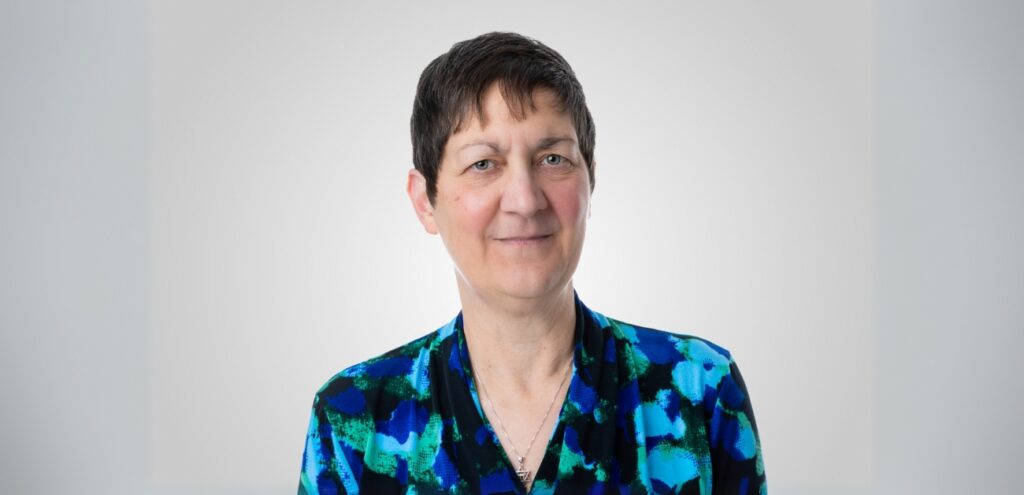
Roberta Clark, executive director of the Jewish Community Relations Council of Milwaukee Jewish Federation, delivered these remarks at the JCRC annual meeting in May 2025. This is an excerpt, lightly adapted for publication.
Community building is hard work, involves perishable skills, and must be ongoing if we are to truly have positive impact in our community. That’s why we’ve titled today’s annual meeting “building brides” because that’s at the core of everything JCRC does.
The work of JCRCs and other Jewish community organizations has changed dramatically since Oct. 7, 2023. We used to believe that as long as we could call an elected leader or faith leader, and they took our calls, we were successful in our work. We were very wrong – real relationships require not just a call or conversation, they require ongoing conversations, willingness to listen to opinions you may not agree with and share opinions which may not be agreed with, striving to find opportunities for collective efforts, and solidarity during moments of injustice.
For a real relationship to be built on behalf of the Jewish community, we must be clear: we believe Israel has the right to exist as the Jewish homeland and that Hamas must be called out as a terrorist organization. We also believe it is possible to be both pro-Israeli and pro-Palestinian and that we believe the Palestinian people also deserve to live in peace and security. Blame should not be placed on the Jewish community in Milwaukee for any decisions about the Israel-Hamas war just as Arab, Muslim, or Palestinian members of our community should not be held responsible for the horrors of the terrorist attack on Oct. 7.
One of the many things we have witnessed over the last 18 months is nonstop rallies, demonstrations, and counter demonstrations. We have witnessed a lot of hatred, and all too often threats towards members of our Jewish community. We have also seen a rise in hatred towards members of immigrant communities, particularly the Latino community, and towards the trans community. Everyone is entitled to their opinion on the many issues in our world; but no one has the right to direct hatred or violence towards another person because of differing views.
While I believe some rallies and demonstrations can have a positive impact in bringing good people together to get to know each other. I have the pretty unpopular opinion that those instances often don’t impact long-term change. Our country and world are the most polarized of my lifetime; so many people are scared, angry, and all too often violent. I always worry that large gatherings have the potential of creating unsafe environments due to an increase in violent counter protests.
I believe we move the needle for long-term positive change in four ways – relationship building (to include dozens if not hundreds of conversations and interactions), education, advocacy, and legislation. Community relations, community building, is a marathon, not a sprint.
One of our challenges as a nonprofit organization, our JCRC is a program of the Milwaukee Jewish Federation, is that we may not run afoul of the Johnson Amendment, which mandates that 501C3s must not advocate for a politician or political party. To make that reality more challenging, in today’s world we are – as individuals and organizations – very often accused of being “political” when someone disagrees with any decision we have made.
So many people seem to function in the realm of absolutes – you are with me or against me, a friend or a foe. It often feels like we are unwilling to consider the real facts, the nuance, which I believe is required in order for positive change to occur. In order for us to advocate on behalf of our Jewish community and other communities, we must remain bipartisan. We need those on both sides of the aisle to care about and advocate for our Jewish community, particularly when it comes to issues of safety and security.
While the Johnson Amendment prohibits us from advocating for or against a political party or politician, our tradition demands we advocate for the rights of each person to be treated with dignity and respect. As quoted earlier:
“What is hateful to you, do not do to your fellow. That is the whole Torah; the rest is commentary. Go and learn.”
Those who are xenophobic – who hate others because of how they are different from them – often hate many, not just folks who identify with any particular immutable characteristic. It’s why I’m proud to be represent our JCRC…
• every time Darryl Morin, who leads Forward Latino, asks me to speak on behalf of immigrant rights at their press conferences;
• or when we need to reach out to Clarence Nicholas of the NAACP – and co-chair with our own Liddie Collins, of the JCRC African American-Jewish Alliance – to offer support for members of the African American community;
• or when we work with Erik Kennedy and our own JCRC Board member Brian DeNeve – our AAPI-Jewish Alliance Co-Chairs – to support the Asian American, Native Hawaiian, and Pacific Islander Heritage community;
• or when we show up to support Ukraine with Wisconsin Ukrainians at their press conferences;
• or when we provide support and guidance to Milwaukee trans leaders and members of our J-Pride group.
I am proud to represent our JCRC and stand with these leaders, among others, against hate and for creating environments of respect – where we strive to treat each person with dignity and respect.
* * *
The mission of the Milwaukee Jewish Community Relations Council is to speak as the representative of the Milwaukee Jewish community on issues of public affairs and public policy by convening and mobilizing the Jewish community through education, advocacy, social justice and support for Israel.

 Loading ...