

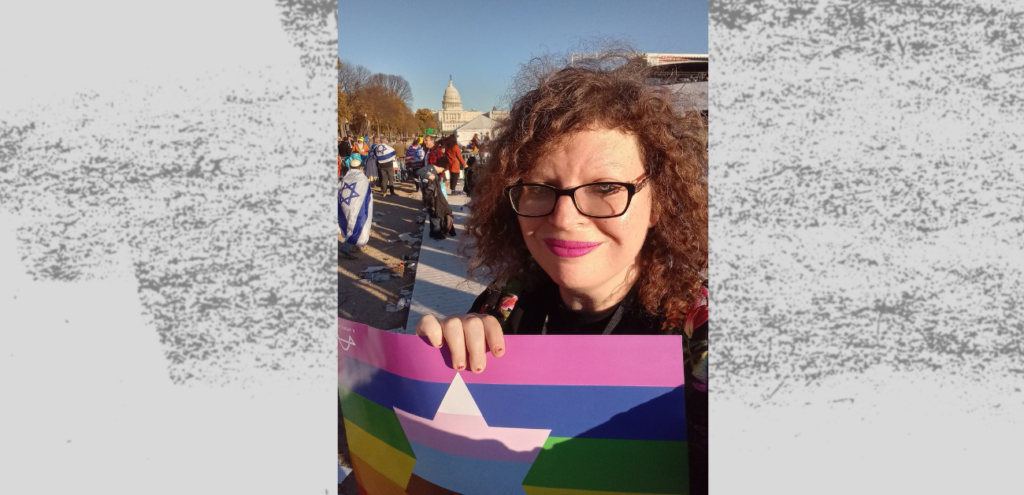
For Jews across the world, Oct. 7 created a darkness felt in parts of ourselves that many of us had not yet been acquainted with. Our emotional response came together like a slowly forming shape, with time needed to fill out and find its edges.
Almost a year later, we now know some of the boundaries within the topography, but the process of finding them has been like building a house with no tools. First, we watched the attack on Israel, our hearts racing in rapid, heartbroken beats. We then found ourselves slapped by an unsympathetic world, both indifferent and hostile to our grief.
In the early months following Oct. 7, a good friend said, “I hope everyone has been in therapy prior to this because this is quite the test of one’s resiliency and psychological well-being.” As someone always up for a challenge, I thought submerging myself in hate could somehow lessen it. I created a Twitter account to antagonize antisemitic people but quit when someone casually told me I would “make a good bar of soap.” I thought sticking my face in the worst qualities of people would somehow end in stories of redemption, because a part of me always believes that there is goodness hidden somewhere. I also confronted a woman in a café who was bullying my mom about Israel. (Don’t worry, the bully is fine — she lives on to disregard any of the geography or history lessons that were shared during our conversation).
I have found that relating these experiences to others can be difficult for me to articulate in a sensical and calm manner. Many of us felt the abrupt reshuffling of our friends—those who valued having a trendy opinion over an informed opinion. We saw hate turn from rivers into oceans, in which we drowned. The loss of safety in Jewish communities was felt from city to city, country to country. We were glued to the UN sessions in the background of our lives, awaiting the 48 Muslim majority countries and all others to deem Hamas a terrorist organization (to the sole Jewish one). Instead, they voted against it and cheers broke out in the room. We watched to see if people on the streets would object to Israeli women with blood on their pants and protest adults and children stolen from their loved ones. We observed the mask fall off so many (so-called) humanitarian organizations and media corporations, due to peer pressure or influence. Or perhaps because there’s only 15 million Jews on the planet, and we are just simply outnumbered.
As a passionate person, it’s mind-blowing that I can have no impact on the hate. I always felt I could influence the world in my own way, but trying to move through hate is an impossible feat — it’s stronger than concrete, unyielding, unmovable. I find myself fascinated with hate — what is it and what cures it, if anything? How does selective empathy form on the outside, and what conditions does it require to disregard or value certain deaths? Many of us have come to the realization that the murder of so many Jews (and hostages) has not been met with the significance it deserves; and therefore, casts our view of humanity in a different light. The fact that so many Jews worldwide feel isolated and hopeless indicates that our countries did not provide the light we needed many months ago. As our eyes are cast on the darkness of the societies we live in, we get a unique, up-close glance at the world’s oldest hatred. Apathy, indifference, hate, neglect, blame, justification for violence, inaction – weren’t these the stories we grew up reading? Amidst my vision readjusting to the dark, I grieve for my idealism, for the spaces in between hate and those that I love, and for opportunities of bravery lost when it would have meant everything.
Shortly after Oct. 7, I asked my mom if she believed people were good. Always the hero to me, she answered, “Of course I do.” I pointed at the TV and asked, “How? How can you possibly think so?” She responded, “Because I choose to. I want to live in a world with good people, so I choose to believe it.” I thought about her answer for months, impressed by how profound and resilient it was to me. I found myself reminded that one can acknowledge the darkest parts of humanity, but also pay attention to the best parts of people and to the things that develop their growth, love and joy. There are close connections, even when the topics hit grim subjects. I started building an internal world that could contrast the harsh realities of the world I existed in.
For any person who laments how hopeless things are, I have something in my sight that says otherwise. On the darkest days, I have been reminded that humans are capable of wonderful and heroic acts. That humans can be kind, nurturing, funny, wise, curious, inspiring, and that we all have our own expansive universes for helping us through these periods. While hate is unbending, there is so much good in the world that moves like a breeze.
For my fellow Jews, even on the darkest days, there is magic to be found in the world we have lived in for the past year. There are soft and gentle sides to us that may not have been able to exist for the last while, but there is magic to autumn days and candles, pretty walks and conversations where we just laugh nonstop, new experiences, deep connections. The topography hasn’t settled completely, but we can add some pretty things to it, because we deserve meaningful lives. At any point, you can build yourself and your life into things which give you beauty and inspiration. You can find the parts of yourself that hurt the most, and within them, hang string lights, plant hydrangeas, put up pretty paintings, and pictures of the heroes in your life. And for those who have supported us through these wild mood swings while exhibiting some very unadorable traits, thank you for loving us through them.
* * *
Simone Bruch was raised in the Milwaukee area, and after living in London, Munich and Chicago, returned in 2019. She lives with her husband and two dogs, and enjoys writing, making art and gardening.


 Loading ...