

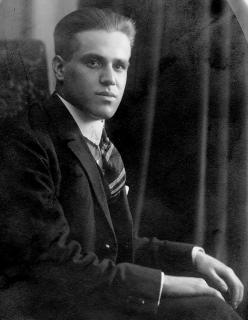
If not for a disagreement with the people he worked for, Carl Laemmle might have spent the rest of his career in a store in Oshkosh.
Laemmle, who had come to the U.S. when he was 17, had been working in Oshkosh for 12 years when he quit and went to Chicago.
He got involved in the movie business, and subsequently, in the way of the American dream, became the founder and head of Universal Studios in California.
Laemmle, unlike many of his fellow movie moguls, was proud of his Judaism. He was one of only two movie tycoons — the other was Jack Warner — who made a Passover seder in his home.
But more than that, there is something to recall about him in this season of Yom HaShoah (Holocaust Remembrance Day).
Before his death in 1939, Laemmle helped to rescue hundreds of Jews from Europe before World War II and the Holocaust began — in fact, before many of Europe’s Jews and the world understood the danger.
Laemmle, who came from the German city of Laupheim, started in the early 1930s bringing as many of his relatives to the United States as possible. He revisited his home town often after he had become rich and powerful, trying to help people in the town and the town itself.
Since 1921 restrictions were tightening in immigration from Europe. Affidavits of financial responsibility had to be made by those wanting to come to America.
Laemmle obtained about 200 affidavits and assumed financial responsibility for not only many of the Jews of Laupheim, but many more German Jews whom he had never met. He persuaded 10 of his friends to obtain 100 more such affidavits.
Laemmle sought out and pleaded with many influential non-Jews to help spread the word and to help the Jews come to America.
In 1932, he wrote a letter to publisher William Randolph Hearst telling him of his fears about what German Nazi dictator Adolf Hitler would do to his people if he came to power. Because of this letter, when Hearst met with Hitler in Germany in 1934 he told him he must not harm the Jews.
Laemmle pleaded with others like Cordell Hull, the U.S. Secretary of State, to allow more affidavits for the Jews to immigrate. When the infamous situation with the German ship St. Louis came up he tried to convince President Roosevelt, but to no avail, to let the passengers into the United States.
One-man crusade
There is a book about Laemmle by a non-Jewish historian in Germany and a school named after Laemmle in Laupheim. Yet Laemmle’s advocacy for his people and the lengths to which he went to help get Jews into the United States has been little known in this country for a long time.
However, Sanford Einstein, 69, has been trying since 2010 to let as many people know about this generous man as possible. He’s made it a one-man crusade.
Einstein is the son of Hermann Einstein, a cantor and Hebrew teacher from Laupheim, whom Laemmle personally brought to the U.S. “Basically, I would not be here if it weren’t for Carl Laemmle,” said Einstein, who lives in the San Francisco Bay area.
Einstein is a long-time entertainment executive. He said his father had never spoken much about the past, “and I didn’t care.”
But in 2010, long after his parents’ deaths, he decided to look in a box his mother had left to him, and there he found letters, including one from his father to Laemmle. That launched Einstein’s quest to learn the story.
Einstein’s father met Laemmle at a party in Germany in 1929 and they took a liking to each other. According to Sanford Einstein’s article in the Tablet online magazine of Sept. 24, 2014, his father wrote to Laemmle in 1937 for help.
Laemmle made another visit to Germany, and when he returned home to Hollywood in February 1938, Hermann Einstein went with him. He lived in the Laemmle home until Laemmle died and was one of the pallbearers at the funeral.
Though Sanford Einstein has been frustrated about the difficulty of letting the world know about Laemmle’s rescuing, he has had several successes.
He has been able to have an article about Laemmle and his saving Jewish souls in the Jewish Journal, Los Angeles’s Jewish paper, as well as Tablet. His pièce de résistance was an article about Laemmle published in the New York Times.
Einstein does not want to stop with articles. He wants to make a documentary film about Laemmle, but said trying to do that has been even more difficult than trying to get articles. As he said, “Where’s the funding going to come from?”
Arlene Becker Zarmi of Shorewood is a freelance writer whose work has appeared in more than 40 publications nationwide, and is a Jewish genre and portrait artist.


 Loading ...